Traveling Blind: A Sensory Experience


Yosemite National Park-El Capitan

Yosemite National Park-El Capitan

The world is a book, and those who do not travel read only a page.

Saint Augustine

My husband and I just returned from a trip to California. We visited Yosemite National Park, San Francisco, Muir Woods, Carmel, and Sonoma Valley. He is an excellent vacation planner and travel companion! This was one of my favorite trips with such a variety of experiences and adventures: hiking among the giant Sequoia, picnicking and wine-tasting in lush wine country, riding the rickety trolley car, shopping in the “hippie” district in the city, lunching on dim sum in colorful China Town, sipping tea in the peaceful Japanese gardens, meandering in the serenity of Cathedral Grove among the regal Redwoods, walking the dog-friendly beaches with my guide dog Sophie, breathing in the fresh, crisp air on the Coastal Trail, feasting on local seafood and wines…ahhh…I am still basking in the glow of the sweet sensory memories of it all!                                                                                                                        

Matanzas Creek Winery-Sonoma Valley

Matanzas Creek Winery-Sonoma Valley


A couple and guide dog at the base of a giant Sequoia tree

The Mighty Sequoia Tree


Where ever you go, go with all your heart.

Confucius

As I was packing, I marveled at how little I needed in my suitcase. A mere 46 lbs. of worldly trappings and accoutrements to survive a twelve day trip was all I required. I have learned to keep it simple. That way, there is less to organize, keep track of, and haul around! I love this sense of freedom from material things and it creates room in my soul to take in the new experiences. It is enlightening to consider what we can live without and how freeing it can be to shed extra baggage.

Though we travel the world over to find the beautiful, we must carry it with us or we find it not.

Ralph Waldo Emerson

In the past when I have traveled as a visually impaired person, I often experienced overwhelming fatigue, anxiety, and even irritability while trying to adjust to new surroundings. This would cause stress  which took away from the ability to enjoy the adventure. This trip was different somehow. I have learned to relax and accept my limitations. I try to pace myself, yet challenge myself at the same time so as not to miss a worthwhile attraction. For instance, we chose to take a two-mile “moderate” hike to Glacier Point in Yosemite. It took us a few hours to painstakingly navigate a rocky course to reach a spectacular summit view. My guide dog was an amazing and attentive partner as she moved me through the obstacles of rocks, logs, and roots. My husband patiently gave me verbal instructions and a steady arm when needed. It took teamwork and concentration as the three of us plugged along the path. The payoff was arriving at the highest point in Yosemite, surrounded by unmatched grandeur; sparkling granite cliffs, terraced waterfalls, and a feeling of infinite openness and space. It was exhilarating and energizing! And the satisfaction of accomplishment spurred me onward. As visually impaired people, we sometimes have to find a different way to do things and take our time-but what joy there is in success and the experience.   

Ft. Funston Beach

Ft. Funston Beach

Certainly, travel is more than the seeing of sights; it is a change that goes on, deep and permanent, in the ideas of living.

Mary Ritter Beard

From the moment we arrived in California, I sensed the differences. The air was cool and crisp with a woodsy herbal scent. The birds sang different songs. Trees have unique silhouettes and shades of color. The sky was bigger and bluer than in Georgia. Flowers seem to be more bold and varied. There are ever-present views and briny smells of the ocean. Foods and people from all parts of the world abound. Travel is about appreciating the differences and variety which the world has to offer. I may not “see” all the sights, but I can employ all of my senses to enrich my experience and celebrate the joys of travel. It is about being there and “being present.”

Pleasure is the flower that passes; remembrance, the lasting perfume.

Jean de Boufflers

A special benefit of this trip was the opportunity to truly enjoy the company of my husband. With the distractions of home, work, and other responsibilities left behind, we were able to tune in to each other fully and refresh ourselves together. Long walks and talks on beautiful beaches can rejuvenate the mind, body and soul. I discovered that each day I could not wait to get up and going, as it meant more time with Kevin. His undivided attention was luxurious and the lazy days together felt extravagant. I wanted to make the most of “him and me” time. So travel is also about the joy of being with your loved ones. All the adventures, sights and experiences are richer when shared and the memories sweeter when made together.
Why I LOVE My iPhone!

I was the last one in my family to have an iPhone. I resisted it for some time, feeling intimidated by the technology. Eventually, I got one for Christmas at my husband’s prodding. My adult kids were all home and spent time teaching me how to use it, setting the accessibility features and downloading helpful apps. They encouraged me to “just start looking around and using it and you will learn what it can do.” Every day, I learned new functions and began to enjoy this wonder of technology. There are user manuals and tutorials that also helped me learn the iPhone. To my surprise and delight, it did not blow up in my hands or anything!
I have Retinitis Pigmentosa and am able to see a little in a narrow field. I use my magnification eyeglasses to read the screen and also use the vision accessibility features. I have inverted the color scheme, white bold letters on a black background for increased contrast and decreased glare. I enlarge the font and can zoom in when needed. As I lose more vision, I will be able to transition to the voiceover option, where the screen is read out loud to me.
It was important to me to be able to maintain communication with my children and family. Now I am able to text, email, message on Facebook, and take photos and send them to stay connected. I use the Siri feature and dictate texts, emails and messages so I do not have to struggle to type them on a small keyboard. Siri works beautifully and there is auto correct spelling too. I can even ask Siri, the personal assistant questions and she can answer them.


The iPhone has so many built-in features and apps that it eliminates the need for many other devices. It has GPS, stores your personal music like an iPod, radio, timer and alarm clock, and voice recorder to take down information. It has a high quality camera and stores and organizes your photos. The calendar can keep your schedule straight for you. There are many apps for the visually impaired such as a flashlight, video magnifier, money reader, color ID and descriptive video reader for movies. Kindle and Nook apps can be used for electronic book downloads. My favorite app is the BARD app from the NLS, which allows me to instantly choose a book from the library, download it and begin to listen immediately. There are even some fun and educational games like Words with Friends and Scramble that I can access. Most of the apps I use are free and I have everything I need in one handy, amazing device.


My iPhone has truly allowed me to be more independent with communications, web searches, finding businesses and services, and managing my time and schedule. I am still discovering new capabilities and having fun with it. Once you get over the intimidation of the technology and begin to use it, it becomes more intuitive and you will wonder how you ever lived without an iPhone.

Musings of a Visually Impaired Mother

I come from a long line of mothers. Women have been birthing babies since the beginning of time. You know that excruciating moment during childbirth when you are screaming “I can’t do this!” and then you dig deep and discover you can after all? I told myself in that moment “If my mom could do this seven times (yes, seven!), then I can too!” And then when the nurse placed my squalling, slimy, bundle of joy in my arms for the first time, I suddenly realized the labor was not even the hard part of being a mother.

I learned that I was expecting my first child from a neurologist, who was working me up for some unknown vision problem. The news was dulled by the uncertainty of my diagnosis. But I decided in the end that it was indeed good news and worth celebrating. Like every other expectant mother, I began to plan and dream of the days to come with my first baby. Before I knew it, my husband and I had two more babies, each two years apart; two boys and a girl in between. When I told my mother I was pregnant with my third she asked me “How did that happen?” and I replied “Oh, the usual way, Mom.”

The baby years are largely a blur, especially after the third one. It was a time of sleepless nights and exhausted days; the tired years. Someone always needed something from me. I remember feeling like a 24- hour Dairy Queen. I constantly “wore’ a baby around my neck or on my hip and my clothes were often adorned with baby body fluids. My body was no longer my own. But I remember those years with a special sweetness and wonder at what my husband and I had created together. There was sheer joy in cuddling my precious babies, taking in their milky breath, sleepy grins, and clutching fingers. During that time, I still did not know what was wrong with my vision and I didn’t think about it much.

Life got a bit busier during the toddler years. I call them the “sticky” years; Cheerios stuck to the kitchen table, gooey jelly fingers and tacky walls and windows. I had trouble conjuring up my inner June Cleaver. I was probably somewhere between Carol Brady and Roseanne on the mother spectrum. I much preferred playing with my children to cleaning up after them. I learned that children are incredibly resilient and durable. Eating a little dirt and even an occasional dead fly off the window sill, did not make them sick. In fact, it may have even boosted their immune systems. Most days, my lunch consisted of half-eaten PB and J crusts gleaned from the kids’ plates as they hurried away from the table. At that time, I finally got a diagnosis: Retinitis Pigmentosa. I began to have a few issues like tripping and bumping into things. One day, while running after my youngest son who was headed for the street, I fell into a hole and broke my ankle. It was also during these years that I lost my driver’s license due to vision loss. This put a huge cramp in my style and an extra burden on my husband. Gone were the days when I could just run up to the store for diapers and milk.

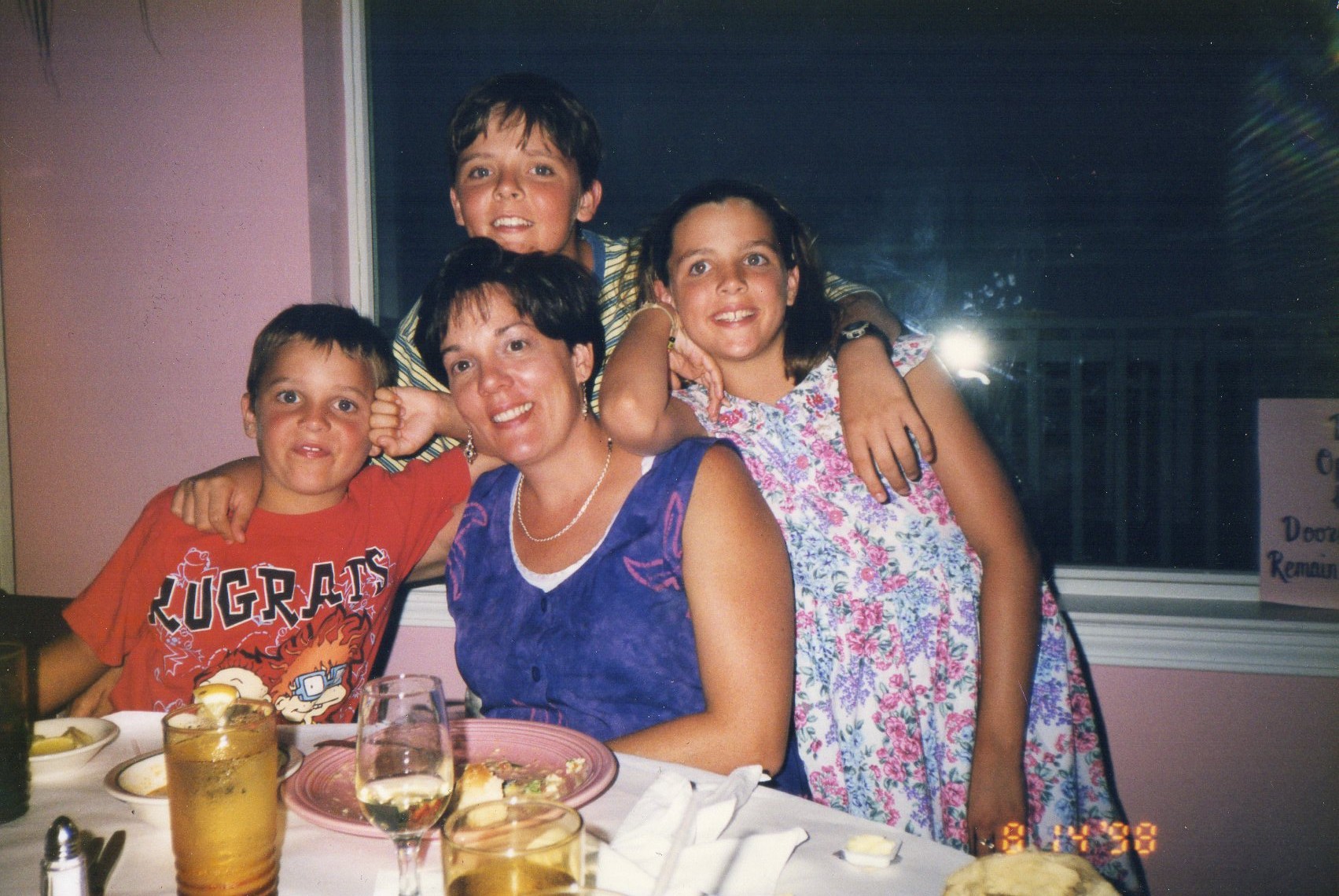
Birthday at the beach-happy and tanned!

Celebrating my birthday at the beach-1995

The school-aged years are remembered as “controlled chaos.” We were in the thick of raising our children while balancing our careers. It took team work and creativity to meet the demands of our busy household. The kids needed rides to baseball practice, ballet, and piano lessons. I needed rides everywhere; to the grocery store, haircut and doctor appointments, and to work. Transportation was the biggest challenge for our family. We were fortunate enough to have friends and neighbors who were supportive. I offered services like after-school care or baked muffins in exchange for rides for my family. It required careful orchestration, but we got where we needed to go and survived those busy years. As my vision deteriorated my children learned to pitch in and help. They learned to guide me and give me descriptive narration at ball games and movies.    

During the teenaged years, when aliens take over kids bodies, it’s difficult to have a visually impaired mother. Now adults, my children admit it was sometimes painful and embarrassing for them. One year on Mother’s Day, we went out to dinner at our favorite restaurant. We were escorted to the table and I began to sit down on what I thought was a bench and went crashing to the floor. I looked like a bug on the rug, my dress crumpled to my waist and arms and legs flailing. I began to laugh so hard that I could not get up. My three teenagers were mortified and asked to leave the restaurant. We stayed. For them, my vision loss was an aggravation and an inconvenience. They had to take turns driving me on errands, much to their chagrin. For me, it was becoming an all-consuming struggle to keep up at home and work. By now, reading print and mobility were my biggest issues and I needed to learn new ways of doing things. I needed to embrace technology and my earliest computer lessons came from my kids.

Before long, my sweet little babies were grown and off to college. Our house became empty and quiet. All too soon, the years flew by, leaving me with the echoes and trappings of child rearing. My role as a mother has changed from caregiver to counselor, confidante, cheerleader, and consultant. As I look back, I can honestly say I relished each phase of motherhood. My children and my husband made it easy for me to be a “good mother” and I have often joked that “they were so easy, they practically raised themselves.” Despite my anxieties and limitations as a visually impaired mom, my kids have said they feel they had a very “normal” childhood. And I can see many wonderful qualities in them which resulted from growing up with a visually impaired mother. Compassion, empathy, cooperation, advocacy, problem-solving skills, resourcefulness and patience are among them. My adult children are truly my favorite people in the whole world.

In truth, motherhood is hard work and it requires intentionality, resilience, and patience. Fortunately, we are naturally endowed with a certain measure of courage and grace to be mothers. The other necessary things, we find amidst the love and laughter of our children. Even vision loss cannot suppress the joys or dampen the pride of being a mother. My humble advice to other visually impaired mothers: don’t sweat the small stuff, keep it simple, live in the moment, and don’t aim for perfection because you will miss every time

Rags to Rugs: a Homespun Art Form

When I retired, I began a mission to fill my time and avoid boredom. I was not really ready to retire and actually feared it immensely. Now in my sixth month of retired life, I cannot even imagine how I ever had the time to work! It has been so enjoyable exploring new interests and establishing a new kind of “busy-ness.” What do I do all day? Well, I do many things that I never had the time for when I was working. I have always been a crafty type. In the past, I have dabbled with quilting, cross-stitching, lace net darning, basket weaving, paper making, stamping, and scrap-booking. Over the years as I lost vision, I gave some of these activities up. But I have never given up on my need to have a creative outlet and am always in pursuit of the next craft I can do with limited vision.

 
I discovered making rag rugs out of old sheets. I taught myself by watching YouTube videos. There are several ways to make rag rugs. I settled on learning how to make Amish Knot, or toothbrush rugs and crocheted rugs. It is a large and tactile craft, so I can do it with very little visual input. I set about collecting bed sheets from the thrift stores in all colors and patterns. My husband helps me tear them into strips, using a technique from Aunt Philly’s YouTube video in which the whole sheet can be torn in just minutes. I use Aunt Philly’s toothbrush tool which I bought from amazon.com for the Amish Knot rugs and a Q hook, available at Walmart, to crochet rugs.

 
At Christmas, I made rugs for all of my family and friends. I made round, oval, rectangle and half-circle rugs of all colors. For my son’s rug, I used an old Ninja Turtle sheet he used as a child for a special touch of nostalgia. I am obsessed with this new endeavor and am perfecting the art of mixing the colors and learning new techniques and designs. I love the homespun charm of this eco-friendly craft. The slubs and imperfections give character to each rug. There is no pressure to create a perfect rug…at the end of the day, it is a rug and will be walked on.

 
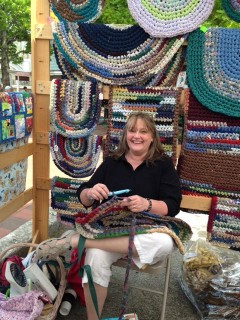
Recently, I attended a bluegrass festival called “Bear-On-the-Square” in Dahlonega Georgia. All the vendors had to display handcrafted and locally made products. I came upon a booth named Rena’s Treasured Gifts and to my great excitement, met a fellow rug maker! Her rugs were beautiful and there she was, working on another one in her lap. We chatted like old friends and swapped tips and ideas. Rena helped me with a few problems I was having and demonstrated how to fix them. I returned home, inspired to make more rugs. Maybe I too will sell them one day.

Rena's booth at "Bear-on-the-Square Festival

Rena’s booth at “Bear-on-the-Square Festival


women and her handmade rag rugs

Look at those beautiful rugs!


handmade colorful rag rugs

A few of my own rugs


  When my kids complained they were “bored,” I always said “Boredom” is a choice. Find something to do or I will give you something to do.” It seems I have no problem finding things to do in my retirement. Between exercising, cooking, crafting, volunteering, yoga, reading, spending time with friends, writing, blogging, walking and playing with my dogs, the days fly by! (Notice I did not include cleaning in the list-I do as little of that as possible). Life is GOOD…


            “Busy Hands Make Happy Hearts”


More Women Than Men Have Vision Loss

We all know men are from Mars and women are from Venus. But you may be surprised to learn there are gender differences when it comes to eye health. As a nurse and a woman with a visual impairment, I was surprised to learn there are more women than men who are blind or visually impaired. I have a degenerative eye disease called Retinitis Pigmentosa and have been legally blind since 1994. Though this condition is genetic and untreatable, there are many steps I take to preserve and protect my remaining vision. And I want to urge other women to take good care of their eyes so they will last a lifetime.

 
Women’s Eye Health Task Force reports that nearly two-thirds of all visually impaired and blind people in the world are women. More women than men suffer from eye diseases such as cataracts and macular degeneration. Research has shown there are gender specific symptoms, conditions and risks associated with vision loss. April is Women’s Eye Health and Safety Month. It is a good time to learn about women’s eye health issues.

 
Prevent Blindness America or PBA, reports similar figures for the U.S.; 66 percent of people who are blind or visually impaired are women. Women have more risk factors and thus, higher rates of vision loss than men. To make matters worse, a recent survey done by PBA revealed that only 9 percent of women realize these troubling facts. Many blinding eye diseases can be treated to prevent blindness and almost all eye injuries can be prevented. Therefore, women need to know what their risks are and learn ways to preserve their vision. PBA launched a new program called See Jane See: Women’s Healthy Eyes Now to educate women on their unique eye health needs.

 
Women are more likely to lose their vision for several reasons:
1. They live longer than men. Many eye diseases are age-related. As women live longer than men, they are more likely to be affected by conditions such as cataracts, macular degeneration and diabetic retinopathy. The rates of these diseases are increasing as the population ages, especially among women.
2. Some eye diseases are intrinsically more prevalent among women. For instance, dry eye syndrome which is believed to be linked to hormones is two to three times more common in women than men. Hormonal changes across the life span of a woman, from pregnancy to post-menopause, can influence vision changes. Women also have higher rates of autoimmune diseases such as lupus, rheumatoid arthritis, and multiple sclerosis. These conditions often have serious effects on the eyes, causing vision loss.
3. Social and economic factors can limit the frequency, quality and availability of health care for women. Since blindness and vision impairment can be prevented through early detection and treatment in some eye conditions, access to proper eye health care is believed to influence the greater rates of vision loss among women.
4. There are behavioral and environmental factors that can increase the risk of eye problems, though they are not specific to women. Among them are poor nutrition and obesity which can cause diabetes and subsequent diabetic retinopathy,a leading cause of vision loss. Smoking is also a proven risk factor for eye diseases, including cataracts and macular degeneration.

 
Women can help themselves and their families to lower the risks of vision loss by educating themselves on eye health and following these guidelines:
1. Get a comprehensive, dilated eye exam at age 40 and continue these exams every two years. If you have a family history of an eye condition or have been diagnosed with an eye disease, follow the recommended schedule of your eye doctor. If you experience any vision changes, eye pain, signs of infection, or eye injuries, see an eye doctor right away.
2. Quit smoking! Smoking affects many organs in the body and the damage is irreparable. Heart disease, lung cancer, stroke and other vascular problems have long been known as good reasons to quit smoking. Now you have another: blindness. Talk to your doctor about ways to “kick the habit.”
3. Maintain a healthy body weight. Start a weight loss or management plan to accomplish this goal. A healthy body weight lowers your risk for heart disease, stroke, and diabetes which can all cause loss of vision. Be sure to include daily activity in your plan as this has many health benefits that can protect your vision. Begin with 30 minutes of walking at least three times a week.
4. Eat an eye healthy diet, rich in colorful fruits and vegetables. Foods containing carotenoids and anti-oxidants such as green leafy vegetables, and fruits high in vitamin C, like oranges, strawberries and melons, may protect eye health. Also include foods rich in omega 3s such as nuts, salmon and egg yolks in your diet. There are supplements available to maintain eye health which contain these micro-nutrients, but it is best to eat fresh, whole foods in a variety of colors to get the best nutrition from your diet.
5. Protect your eyes from harmful sun rays. Invest in good quality sunglasses that have full UV-a and UV-b protection. In beach and snow conditions, darker tints are needed to filter out the harmful rays. Wear ball caps or hats with a wide brim for additional protection from scattered rays that reflect off of surfaces. Avoid prolonged periods in the sun without eye protection.
6. Use cosmetics and contact lenses safely. Wash hands and face thoroughly before applying contacts and cosmetics. Keep contact cases, make-up brushes and applicators clean. Throw away eye shadows, eye liners, and mascaras after three months. They expire and can become a breeding ground for bacteria. Do not share makeup. Follow the recommended wearing and cleansing schedules for your type of contacts.
7. Learn proper eye safety and first aid for home, work, and recreational environments. Wear protective eye gear such as goggles when using chemicals, tools, and machinery. It is important to protect the eyes from burns, cuts, and foreign objects that can damage the corneas and other structures of the eye.

Note the sunglasses and ball cap..who cares about "hat-hair??"

Note the sunglasses and ball cap..who cares about “hat-hair??”

My sister Adrianne and I, taking a morning walk in the beautiful Arizona desert

My sister Adrianne and I, taking a morning walk in the beautiful Arizona desert


Women live very busy lives juggling the demands of jobs, children, their households, and aging parents. We often play the caregiver role, but sometimes neglect our own self-care. You may take your child for eye screenings or an aging parent to the eye doctor, but when did you last have an eye exam yourself? The power to prevent vision loss is in your hands. Awareness and knowledge are the tools you need. Your sight is precious-save it! Treat yourself to an eye exam today.

 
Learn more at:
http://www.visionproblemsus.org
http://www.lighthouse.org/eye-health/womens-eye-health

Darkness

A story in fifty words…no more…no less. The Daily Post Challenge: Fifty

eyes


Tensely gripping the armrests, she received the ophthalmologist’s proclamation. The weight of it slammed into her chest.

 
“You will lose your vision…nothing can be done…”

 
He placed the heavy mantle of loss over her shoulders and a darkness settled upon her.

 
“Go now and live your life…” he said dispassionately.

Enough

This post is a response to a writing challenge from The Daily Post. The instruction was to write a story of exactly fifty words. It is called “a fifty.” I began to think of memories and scenes in my head that would lend themselves to this economy of words, a succinct picture in words. As I am new at the art of blogging, I am at times stifled and worried that I do not have “enough”  of interest to write, or “enough” talent and creativity. But that is not so…

This story is a true story. We met a beggar boy, no older than 5 years, on the streets of Lima Peru where we took our children on a family vacation. We called it a “vacation with a purpose.”  As a family, we worked in an orphanage, each of us with our own job to carry out. My children ate and played with the orphans at Kids Alive. They saw first-hand the effects of poverty on a child. These discarded children had nothing but lice, scabies and whatever bits of trash they could hoard before arriving at Kids Alive. And yet…they were full of life, joy and gratitude since they had been rescued from the trash heaps and brought to the orphanage. There they were given 2 outfits of clothing, a school uniform and supplies, 3 meals a day, medical care, a bed and a roof over their heads. To them, it was pure luxury and they were living in paradise! Enough is clearly a matter of perspective and experience.

The purpose of this trip was to teach our children to be grateful for what they have and to realize how much of the world does not know the excess in which we live as Americans. We wanted them to learn the joy of sharing what they have with others. It was important to us that they learn to treat all people with dignity and respect, since we are all the same. And we wanted them to value the right things in life: family, friendships, generosity, hard work,  service to others, and gratitude. I dare say the lessons were learned and my children were forever changed by this two-week trip to one of the poorest countries in the world.

“Enough is as good as  a feast”~Mary Poppins


And now for my first “fifty”:


The ragged street urchin sang, playing his broken ukulele. He held out his grubby hand. I gave him an apple and thanked him for his performance. His eyes lit up in gratitude for it was enough to satisfy him until the next wave of hunger pangs. How much is enough?

The Miracle of Seeds

Do you remember the sheer delight of planting a bean in a handful of dirt in a Styrofoam cup and watching it grow as a child? There is nothing quite as wonder-filled as a seed. The variety of color, shape, fragrance and flavor contained within that tiny package is a miracle. It is spring now and miracles await to delight, inspire, feed and calm the soul.

“In every gardener there is a child who believes in The Seed Fairy.” ~Robert Brault

I remember the first time I planted my own vegetable garden. Enthralled with the simplicity of the seeds, I lavished them upon the tilled ground with great enthusiasm. Imagine my excitement as they burst forth in varying shades of green, tender shoots. Honestly, I was astonished and thrilled at the power I discovered in my own hands to cultivate. And I was humbled by the earth’s desire to give me such beautiful and useful gifts. Daily, I would “walk the plantation” and assess the new growth in my garden. As the summer wore on, I was blessed by more tomatoes and beets than anyone in my family wanted to eat and a mammoth pumpkin vine that threatened to swallow the house. Soon, I realized I needed to learn how to preserve the generous bounty of my over-ambitious garden. At harvest, the kitchen was abuzz with the activities of canning and freezing the colorful, fresh vegetables. And I was hooked on the yearly ritual of placing the diminutive, surprise parcels into a bit of dirt and waiting for the anticipated joy of new life.

“Gardening is cheaper than therapy and you get tomatoes.” ~Author Unknown

It is well-accepted that gardening has a therapeutic effect on humans. Many an author and poet have extolled the benefits and special powers that plants have on us. There is even such a thing as horticulture therapy, which is used to rehabilitate people. There is something very calming and soothing about the process of playing in the dirt in the warm sun and nurturing plants to grow. Throughout my life, I have dabbled in all kinds of gardening. It seemed that I was always happiest when I was planting, growing, and caring for plants. When I lived in a rural setting, it was a large vegetable garden. Then, I studied perennials and herbs and planted them for their different uses. I even had an indoor garden of over 20 African violets for years. I used to say to my kids “Look, the violets are all blooming! That means momma is happy!”

“At the heart of gardening is a belief in the miraculous.” ~Mirabel Osler

Over the years, due to my vision loss, I have scaled back my gardening. But I always have something growing to remind me of the miracle of life. Now, I have a small herb garden in an antique bathtub on my patio. I maintain large pots of annuals that spread their cheer in spring and summer. I love to plant sunflowers for their big, bold blooms and seeds to feed the birds. At Christmas, I like planting an amaryllis bulb in a pot. My children used to measure the daily growth and marvel. Indoors, I keep several easy-to-grow plants that add color and oxygen to the sunroom. I will never be without my plants. They are such simple pleasures.

“Plants give us oxygen for the lungs and for the soul,” ~Linda Solegato

So, if you are in need of a little joy, pleasure, sunshine, surprise, inspiration, or stress-relief, consider plant therapy. Start small. Start with a seed and a Styrofoam cup. A world of wonder awaits you.

Edible Spring Greens  Garden-in-a-Bag

Edible Spring Greens Garden-in-a-Bag

*Here is an idea I came upon for a simple way to make an edible, low-cost, low-maintenance, container garden of salad greens and herbs. (Facebook/ North Texas Vegetable Gardeners/Fun Facts and Tips for Everyone):
1. Buy a large bag of potting soil like Miracle Grow (2 cubic feet)
2. Gently break up the soil in the sealed bag. Poke lots of holes for drainage on the back of the bag. Place it label side up on a smooth surface where it can drain, such as a raised rack or table.
3. Cut out the front of the bag, leaving a 4 inch border all around to hold in the dirt. Fluff and rake the soil evenly.
4. Mix salad greens seeds such as lettuce and arugula in an old spice bottle with cornmeal. Sprinkle evenly over the soil. (cornmeal helps you to see that the seeds are distributed evenly) Cover seeds with a dusting of dirt.
5. Plant spinach, radishes, or herb seeds in rows at the recommended depth on seed package.
6. Spray mist the seeds and young plants until well established. Water more vigorously when the plants are mature. Keep the soil moist, but not wet.
7. Harvest the leaves by cutting what you need with scissors. The plants will continue to produce new leaves. Enjoy your “greens”!

Sometimes You Just Gotta Laugh!

For a visually impaired person, life can become a series of mishaps and embarrassing moments. Sometimes there are real dangers and injuries involved. Other times, just awkward situations arise that are actually quite funny if you can find the humor in them. In the early stages of vision loss, I thought I was becoming very clumsy. Now, I try so hard to use my rehab training to move through space with style and grace. I was used to appearing as a confident and competent person, but Retinitis Pigmentosa changed that. Now I am constantly on the lookout for situations and booby traps that may trip me up and cause an “RP moment”. Here are a few highlights of my personal mishaps. I have learned that sometimes, you just gotta laugh!

Shopping is always a tricky endeavor. One time, I was looking at handbags on a display. As I fingered these beautiful purses, I spotted one that caught my attention. I moved closer to fondle it admiringly and discovered that it was attached to another shopper who was shocked and yanked it away from me. All I could do was apologize and say lamely “I am visually impaired”.

One day, my husband dropped me off at Kohl’s. I entered the store and was overwhelmed with glass, chrome, colors, and shapes. I meandered for a while and then decided to ask for help. I rounded a pillar and spotted someone. “Excuse me”, I said. The person did not respond. I repeated myself a bit louder. “Excuse me, ma’am”…and suddenly I caught a glimpse of a dog…it was my guide dog and I was talking to myself in a mirror! I looked around quickly to see if anyone noticed my “crazy woman” behavior. No one came to haul me away.

After shopping alone, my husband came to pick me up. I waited on the curb for him in the blinding sun. A reddish car pulled up and I hopped in. Then I heard an unfamiliar voice say “What are you doing??!” “Oh-oh”, I stuttered. “You are not my husband!” I awkwardly exited the stranger’s car with no explanation.

Our church service is held in the dark. My husband and I made our way to take our seats and I sat down on another man’s lap. He laughed as I yelped and popped up, causing a scene in the quiet sanctuary. I was hot with embarrassment.

I went to my son’s school one day to visit his classroom. I stopped at the office, got my name badge, and then headed down the hallway. I saw his class leave their room. So I hurried toward them, waving for my son. Suddenly I fell into a bench, face down, feet in the air! It clipped me at the knees. As I struggled to get back on my feet, my son walked by and whispered “Mom, take off your name tag.” He did not want to claim me in that moment.

Dark restaurants are difficult to navigate for the blind. My family took me out to dinner for Mother’s Day. My children were all teenagers at the time. They never got used to the painful, public guffaws of their blind mother. We entered our favorite restaurant and were escorted to a table. I thought I saw a booth and went to seat myself and scoot around. But alas, there was no bench and I crashed to the floor on my bum. With my dress tangled around my waist and my arms and legs flailing, I looked like a beetle on its back. I laughed so hard I could not get up! My children were all mortified and asked if we could leave the restaurant. We stayed.

My son was poised to run the “Tot Trot”. Like all the other eager mothers, I stood at the starting line to help him get off and cheer for him. After they called “On your marks-get set-go!” all the children started running. My eyes were on my son and suddenly I had knocked down several small competitors like bowling pins. I tried to help them up as they cried and their mothers shot me icy looks. I slithered away. My son won the trophy and I am sure the other parents thought it was a low-down tactic to ensure the win.

We all have these “blind moments”. They teach us to lighten up and accept that things are going to happen. Most of the time, laughter soothes the sting and angst. It is good medicine and it feels good to laugh. Life just happens and sometimes it can be very funny. What is one of your funniest blind moments?